Sema Image
Can Thermal Imaging Detect Fever Accurately in Crowds 2026?
Can thermal imaging detect fever accurately in a crowd? It can flag elevated skin temperatures, but it cannot reliably diagnose fever or infection on its own. The distinction matters at a busy entrance, where people move past cameras, sunlight shifts across faces, and a warm drink or recent exercise may affect readings. Thermal systems measure surface temperature, not the body’s internal temperature directly.
The U.S. Food and Drug Administration’s guidance on infrared thermographic systems highlights the importance of controlled conditions and correct setup. ISO/TR 13154:2017 likewise provides guidance for implementing fever-screening systems, including camera positioning and screening procedures. These documents are useful benchmarks, not guarantees of performance in every crowd. WHO guidance also cautions that thermal scanners cannot identify people who are infected but do not have a fever. WHO emergency expert Dr. Michael Ryan has emphasized the same practical limitation: a scanner can flag elevated temperature, but it cannot establish infection.
That gap should shape any 2026 assessment. A camera may quickly direct an individual for a secondary temperature check, yet readings can be affected by distance, airflow, face coverings, and the time needed to acclimatize after entering from outdoors. Small differences matter. A false alarm can interrupt a traveler; a missed fever can create misplaced confidence. Operators should validate equipment under local conditions and explain what screening can—and cannot—tell them. The evidence is useful, but not perfect. Crowds make it harder.
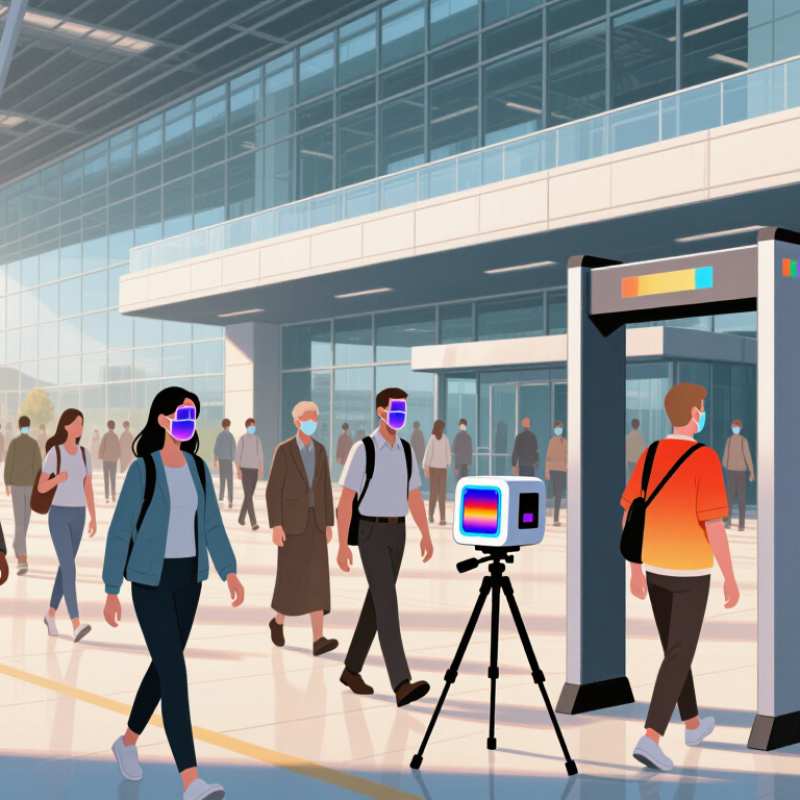
Thermal cameras do not read core body temperature directly. They detect infrared energy from exposed facial skin and convert selected pixels into an estimated surface temperature. In many screening setups, software samples the inner corner of the eye, a region that can be more consistent than the cheeks. A calibrated reference source helps check whether the camera is drifting. The picture can look precise. The estimate is not. A warm face does not automatically mean fever, and a normal-looking reading cannot rule one out.
Crowds make measurements harder. Someone may step in from cold air, stand too far away, or turn their head under warm lights. Glasses, sweat, cosmetics, and hair can obscure skin pixels. If faces overlap, software may assign a reading to the wrong person. Small details matter. There is an awkward gap between a bright spot on screen and a person’s actual internal temperature. Thermal screening works best as a quick flag, not a diagnosis. A raised reading should be checked with a suitable clinical thermometer, following its instructions and the screening protocol.
ISO 80601-2-59:2017 sets requirements for screening thermographs used to detect elevated body temperature. It does not guarantee accurate fever detection in every crowd. The standard’s controlled test conditions matter: stable indoor temperatures, correct camera positioning, and a suitable reference source help limit measurement error. A draft near the entrance can disrupt the reading.
The U.S. Food and Drug Administration’s 2020 guidance advises measuring one person at a time for best performance. Crowds create practical problems: people move, wear glasses, arrive from cold streets, or stand at different distances. These details can shift facial temperature readings. Small errors add up.
A published systematic review reported pooled sensitivity of about 81% and specificity of about 92% for infrared thermal imaging fever screening. Results varied across studies and settings, so those figures are not a guarantee for a busy terminal. A thermograph can flag someone for a secondary temperature check; it cannot diagnose illness. And the setup is easy to underestimate. A rushed calibration, or a sunlit window behind the queue, may weaken confidence in the result.
In a crowded entrance, a thermal camera can quickly identify faces whose skin temperatures look unusually high. It does not directly measure core body temperature, and a flagged reading is not a diagnosis. The distinction matters. FDA guidance for fever-screening systems has emphasized measurement accuracy of about ±0.5°C under controlled conditions. That tolerance is meaningful: a displayed value of 37.8°C could reflect a real difference, instrument uncertainty, or both. Near a screening threshold, a few tenths of a degree may change who receives a secondary check. Accuracy is not a cosmetic specification.
Reliable readings depend on setup, not just camera resolution. Guidance favors measuring one person at a time and using a stable reference temperature source, such as a calibrated blackbody, to check system performance. The inner eye corner is often used because it is less exposed than the cheeks, though glasses, sweat, makeup, airflow, and recent outdoor exposure can still distort readings. Keep the camera at a consistent distance, avoid direct sunlight, and allow people time to acclimate indoors. Small details matter. A busy doorway is not a laboratory; crowd movement and hurried positioning create errors that specifications cannot erase. Staff should treat an alert as a prompt for an approved follow-up temperature check, not proof of fever. Even well-controlled screening can miss cases or flag healthy people, so protocols need regular review.
| Screening factor | Evidence or guidance | What it means in a crowded setting |
|---|---|---|
| Measurement accuracy | FDA guidance for thermal imaging systems used for initial body-temperature assessment describes an accuracy of ±0.5°C (±0.9°F) or better under specified conditions. | This is a device-performance target, not a guarantee that every person with a fever will be identified. A reading near a screening cutoff can be affected by measurement error. |
| One person at a time | FDA guidance describes measurement of one individual at a time for the intended screening setup. | Several faces in the camera’s field of view can make it harder to identify and measure the correct person consistently. A queue or single-person checkpoint is more suitable than scanning a moving crowd. |
| Reference temperature source | FDA guidance discusses using a calibrated reference source, such as a blackbody, as part of the specified thermographic setup. | A reference source helps verify system performance. Without suitable setup and calibration, a displayed temperature may not meet the stated accuracy target. |
| Skin temperature versus body temperature | Thermal cameras estimate surface temperature, commonly around the face; they do not directly measure core body temperature. | Ambient conditions, recent outdoor exposure, airflow, perspiration, cosmetics, and measurement location can influence the surface reading. |
| Fever threshold context | A temperature of 38°C (100.4°F) is commonly used as a fever threshold in clinical guidance, but interpretation depends on measurement method and context. | A skin-temperature reading should not be treated as interchangeable with an oral, ear, or other clinical measurement. Screening thresholds need to match the device’s validated method. |
| Screening versus diagnosis | Thermal imaging can support initial temperature screening; it does not diagnose an infection or establish the cause of an elevated temperature. | A flagged result should be followed by an appropriate confirmatory temperature assessment and, when indicated, clinical evaluation. |
| Practical conclusion for crowds | Accuracy depends on the complete measurement setup and operating conditions, not just the camera’s nominal specification. | Thermal imaging is better suited to controlled, single-person screening than to making definitive fever determinations from a dense, moving crowd. |
Sources: U.S. Food and Drug Administration, Non-Contact Temperature Assessment Devices During the COVID-19 Public Health Emergency (guidance); U.S. Centers for Disease Control and Prevention, general fever guidance. Screening performance varies by device, setup, environment, and procedure.
Crowd movement can turn a thermal camera’s neat image into a misleading reading. A person crossing quickly may blur the face, while a side angle changes the skin area seen by the sensor. Warm air near an entrance, sunlight on a forehead, or cold outdoor air can also shift skin temperature. The camera measures surface heat, not core body temperature. Small disturbances matter.
A 2020 systematic review of infrared fever screening reported pooled sensitivity of about 80% and specificity of about 92%, with results varying by setting. That means some fevers may be missed, and some people may be flagged unnecessarily. The U.S. Food and Drug Administration’s 2020 guidance recommends controlled indoor use and screening one person at a time. Busy queues rarely behave like controlled test rooms. I would treat a crowd reading as a prompt for follow-up, not a diagnosis.
Tips: Place the camera away from direct sunlight and heating vents. Let people pause briefly before screening, and keep faces unobstructed. Check the device against a reference source, as FDA guidance recommends. Record room conditions; otherwise, a surprising reading is hard to interpret later.
Why a Positive Thermal Screen Requires Confirmatory Temperature Measurement
At a crowded entrance, a thermal camera can scan faces quickly without contact. It estimates skin-surface temperature, not the body’s core temperature. Distance, room drafts, recent outdoor exposure, sweat, and camera positioning can all affect the reading. A warm-colored image is a signal to check, not proof of fever.
A positive screen should prompt a confirmatory temperature measurement with a suitable clinical thermometer. Trained staff should follow the device instructions and use a consistent measurement site. Temperature thresholds can differ by method, so results need context. Ask whether the person has symptoms, and follow the site’s health protocol. A normal screen does not rule out illness, either.
Not a diagnosis. Even careful screening can miss cases; that limitation deserves honest attention.
Tips:
Let someone acclimate indoors before screening, when practical. Keep the camera setup consistent, and avoid measuring near strong airflow. Confirm unexpected readings with a clinical thermometer. Record the method used, since numbers from different sites may not match exactly.
No. They detect infrared energy from exposed facial skin and estimate surface temperature. A bright reading is not a diagnosis.
Systems often sample the inner corner of the eye. It may be more consistent than the cheeks, but glasses or sweat can interfere.
People may move, stand at different distances, or arrive from cold air. Warm lights, drafts, and overlapping faces can also disrupt results.
Use a stable indoor setting, consistent camera distance, and a calibrated reference source. Avoid direct sunlight. Small details matter.
The displayed temperature may differ from the actual measurement by several tenths of a degree. Near a screening threshold, that uncertainty can change who gets checked.
No. It can flag an elevated facial skin temperature for follow-up with a suitable clinical thermometer. It can also miss cases or flag healthy people.
One review reported about 81% sensitivity and 92% specificity. Results varied between settings, so those figures are not a promise for a busy entrance.
Recent exposure to cold outdoor air can affect facial skin temperature. A short wait may help, though crowded spaces make this awkward. That limitation deserves attention.
Can thermal imaging detect fever accurately in a crowd? It can help identify people whose facial skin temperature appears elevated, but it does not directly measure core body temperature or diagnose fever. Thermal cameras estimate temperature from infrared energy emitted by the skin, and their results are most dependable when the subject, camera, and environment meet controlled screening conditions. ISO 80601-2-59 describes requirements for screening thermographs, while measurement accuracy around ±0.5°C matters because even modest errors can affect who is flagged for further assessment.
In real crowds, movement, viewing angle, distance, airflow, sunlight, and changes in room temperature can distort readings. A thermal alert should therefore be treated as a preliminary screen, not a final conclusion. Anyone flagged should receive a confirmatory temperature measurement using an appropriate clinical method, with the result considered alongside symptoms and other relevant information. This layered approach makes crowd screening more useful while recognizing its limits.