 Sema Image
Sema Image
Sema Image
Thermal cameras reveal infrared energy, not gas molecules directly. Their images can show heat, plumes, leaks, and changing temperature patterns. However, gas detection depends on spectral sensitivity, camera design, distance, wind, background temperature, and gas concentration. A warm pipe may appear clearly, while a small leak remains invisible. Conditions matter greatly.
Can thermal cameras identify different types of gases? In some cases, yes, especially when using optical gas imaging cameras with narrow infrared bands. These systems may detect methane, carbon dioxide, sulfur hexafluoride, ammonia, refrigerants, and selected volatile organic compounds. The exact list varies between manufacturers and models. It also depends on whether the gas absorbs infrared radiation within the camera’s detection range. Standard thermal cameras usually cannot identify gas composition reliably.
This article examines the top 10 gas types thermal cameras can detect, while explaining practical limits. Field inspectors often compare a suspected plume against a stable background, such as a storage tank wall or bright sky. Calibration, proper focus, and controlled viewing angles improve confidence. Weather can still interfere. Strong wind may scatter a plume within seconds.
The answer is not perfectly tidy. A visible plume does not automatically prove a specific gas. Confirmatory instruments, manufacturer data, and trained interpretation remain important. This guide separates genuine detection capability from marketing claims. It also highlights where thermal imaging supports maintenance, environmental monitoring, and workplace safety without replacing certified gas detectors or established inspection procedures.
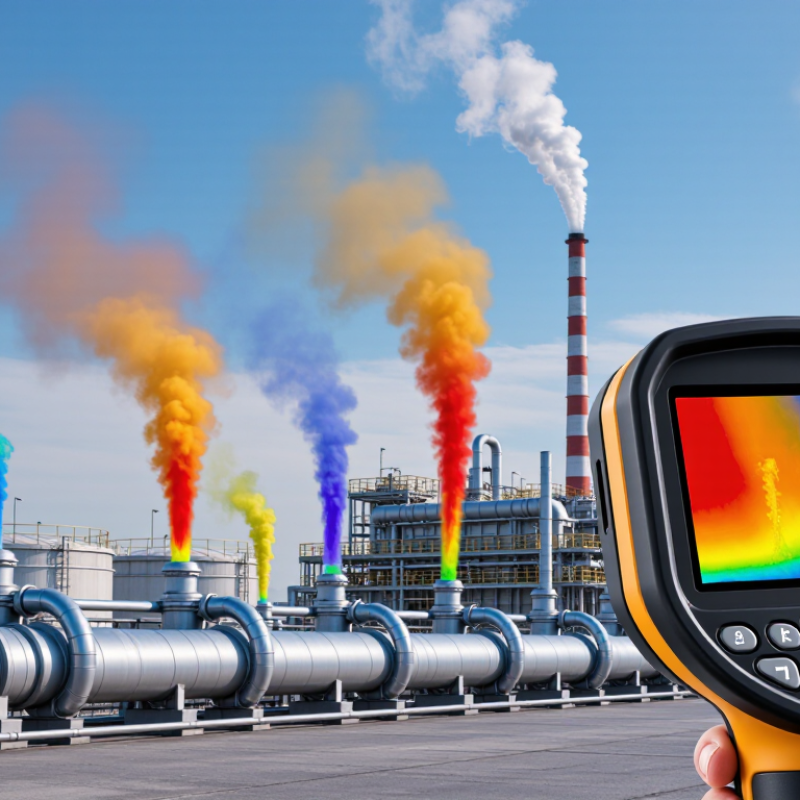
Top 10 Gas Types Thermal Cameras Can Detect
Gas imaging works through infrared absorption, not ordinary visible light. Specialized thermal cameras identify gases by filtering specific infrared wavelengths. Methane, ethane, propane, butane, pentane, hexane, sulfur hexafluoride, ammonia, sulfur dioxide, and selected refrigerants may appear as moving clouds. Carbon monoxide can also be detected with suitable spectral equipment. Detection depends on concentration, distance, wind, background temperature, and the camera’s filter.
The visible plume may look like a soft gray shimmer. It is not smoke. A warm pipe behind a leak can improve contrast, while a cold sky may hide it. The International Energy Agency reported approximately 120 million tonnes of methane emissions from fossil fuel operations in 2023. The WMO’s Greenhouse Gas Bulletin No. 20 recorded atmospheric methane at 1,934 parts per billion in 2023, about 165% above pre-industrial levels. These figures show why rapid screening matters, but imaging alone does not measure every leak precisely.
Tips: Scan slowly, from several angles. Keep the background stable. Confirm suspected leaks with a calibrated detector or laboratory method. Check wind direction before judging the plume. A camera can miss a small release, especially during rain or strong airflow. That limitation deserves attention. “Thermal camera” is too broad a term; reliable gas imaging requires the correct spectral band, trained operators, and documented inspection conditions.
| No. | Gas Type | Important Infrared Absorption Region | Common Leak or Emission Source | What the Thermal Camera Can Show | Important Limitations |
|---|---|---|---|---|---|
| 1 | Methane (CH₄) | Approximately 3.3 µm | Natural-gas pipelines, valves, compressors, storage tanks, landfills, and biogas systems | A moving gas plume or cloud that appears because methane absorbs infrared radiation in the camera’s selected spectral band | Requires a suitable short-wave or mid-wave infrared gas-imaging camera; wind, distance, background contrast, and leak rate affect visibility |
| 2 | Carbon Dioxide (CO₂) | Approximately 4.26 µm | Combustion exhaust, fermentation, dry-ice systems, carbon-capture equipment, and process vents | A visible gas plume when the concentration, temperature contrast, and optical path are sufficient | Ambient CO₂ is always present; ordinary long-wave thermal cameras generally cannot identify it without gas-specific spectral filtering |
| 3 | Carbon Monoxide (CO) | Approximately 4.6 µm | Incomplete combustion, furnaces, boilers, engines, flares, and industrial process gases | A gas plume may be visualized in a narrow spectral band designed around carbon monoxide absorption | It is colorless and highly toxic; specialized optical gas imaging is needed, and visual detection is not a substitute for a certified gas alarm |
| 4 | Sulfur Hexafluoride (SF₆) | Strong absorption in the mid-infrared, including around 10.5 µm | High-voltage switchgear, gas-insulated substations, and electrical transmission equipment | A localized plume escaping from seals, flanges, valves, or connection points | Requires an appropriate long-wave infrared spectral response; detection performance depends on leak size, wind, and viewing angle |
| 5 | Ammonia (NH₃) | Strong bands near approximately 10.3 µm | Refrigeration systems, fertilizer production, chemical processing, and agricultural storage | A plume may be observed around valves, pipes, compressors, and refrigeration components | Moisture, temperature, concentration, and background conditions influence contrast; a dedicated detector is required for safety confirmation |
| 6 | Nitrous Oxide (N₂O) | Strong absorption near approximately 4.5 µm | Medical-gas systems, chemical processes, combustion, and agricultural emissions | A gas cloud or plume may be detected with a suitably filtered mid-wave infrared camera | Not detectable with a general-purpose thermal camera; concentration, path length, and spectral selectivity are critical |
| 7 | Sulfur Dioxide (SO₂) | Strong absorption in the mid-infrared, especially around 7–9 µm | Metal smelting, sulfuric-acid production, combustion of sulfur-containing fuels, and volcanic emissions | A concentrated emission plume from stacks, vents, or process equipment | Atmospheric absorption and interference from water vapor can reduce performance; specialized spectral equipment is necessary |
| 8 | Hydrofluorocarbons (HFCs) | Molecule-dependent bands, commonly in the mid- and long-wave infrared | Air-conditioning, refrigeration, heat pumps, and fluorochemical processing | Refrigerant leaks may appear as a flowing plume near fittings, hoses, seals, and service ports | Different HFC compounds have different spectral signatures; camera settings and filters must match the target gas |
| 9 | Hydrochlorofluorocarbons (HCFCs) | Compound-dependent absorption bands, often in the mid-infrared | Older refrigeration and air-conditioning systems, industrial cooling equipment, and chemical handling | A refrigerant plume may be visible when the leak reaches the camera’s spectral sensitivity range | Many HCFCs are regulated or being phased out; identification requires compound-specific calibration or complementary measurement |
| 10 | Volatile Organic Compounds (VOCs) | Compound-dependent absorption bands, frequently in the 3–5 µm region | Petroleum storage, chemical manufacturing, solvents, fuel systems, and process equipment | Hydrocarbon or solvent vapor plumes may be displayed when the target compound has a suitable infrared signature | “VOC” is a broad category; cameras may not distinguish individual compounds without appropriate filters, calibration, and atmospheric conditions |
Note: Gas imaging works by detecting infrared absorption or emission from a gas plume against a suitable background. A standard thermal camera measures surface temperature and cannot automatically identify every gas; gas-specific optical filters, spectral bands, sufficient concentration, and appropriate environmental conditions are required.
It detects infrared absorption, not ordinary visible light. Specialized cameras may show methane, ammonia, refrigerants, and other gases. The plume can look like gray shimmer.
No. Gas imaging needs the correct spectral filter and infrared sensitivity. The phrase “thermal camera” is too broad. That distinction matters.
Concentration, distance, wind, humidity, and background temperature all matter. A warm pipe may reveal a cooler leak. A cold sky may hide it.
It may appear as a soft, moving cloud near a valve or joint. It is not smoke. Steam, dust, and reflections can look similar.
Scan slowly from several angles. Check wind direction before judging movement. Keep the background stable and adjust focus carefully.
No. Imaging shows possible movement, not always exact concentration. A small plume may still deserve confirmation. Confidence can be misleading.
Use a calibrated detector or laboratory method. Record distance, airflow, surface temperature, and camera settings. Images alone are not enough.
Their infrared absorption can be narrow. Warm backgrounds and long distances may reduce contrast. Specialized instruments may work better than ordinary cameras.
Look around valves, joints, and damaged insulation. A pale cloud may drift briefly beside cold equipment. Gas-specific settings remain necessary.
Rain and strong airflow can hide a release. Similar temperatures can erase contrast. The operator may misread the scene. That possibility deserves attention.
Thermal cameras can reveal certain gases by detecting infrared radiation absorbed and re-emitted at specific wavelengths. Can thermal cameras identify different types of gases? Yes, specialized infrared gas-imaging systems can visualize gases when their absorption characteristics, concentration, temperature contrast, and background conditions create sufficient visibility. Performance also depends on wind, distance, humidity, and the camera’s spectral sensitivity, so detection does not always mean precise measurement.
Commonly detectable gases include hydrocarbon gases such as methane, propane, butane, and pentane, which are important in energy, storage, and process environments. Industrial gases such as sulfur hexafluoride, ammonia, and ethylene can also be identified under suitable conditions. Other gases that may be visible include carbon monoxide, nitrous oxide, and certain refrigerants. These technologies support leak detection, maintenance, safety inspections, and environmental monitoring by helping operators locate emissions quickly without direct contact.
